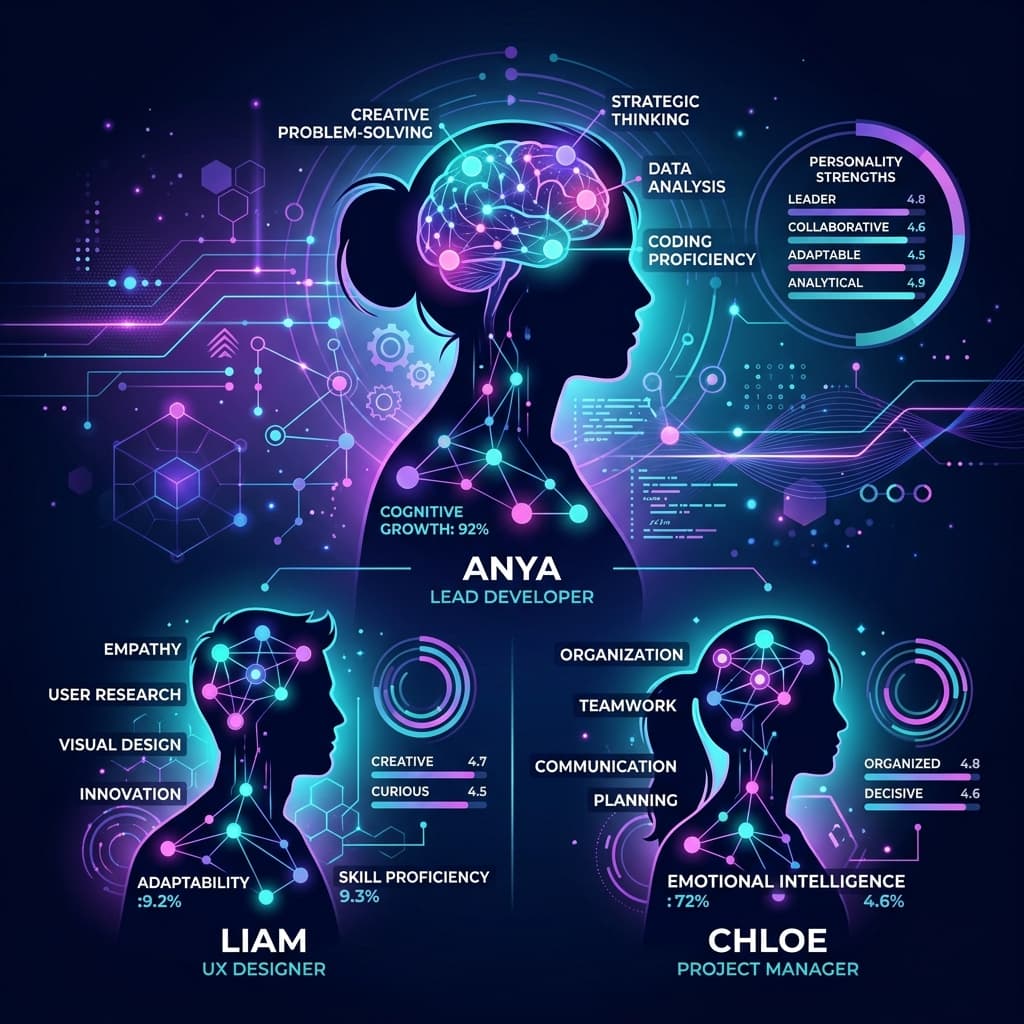
Reconceptualizing Strengths in Modern Workplaces
For decades, recruiters identified "employee strengths" by looking at university logos, previous brand-name employers, and keywords on a CV. However, in 2026, credentials no longer map to actual job performance. A candidate with a degree from a top school may struggle to adapt to rapid software changes, while a self-taught engineer might exhibit world-class coding proficiency and resilience.
To hire effectively, organizations must define and measure **work-related employee strengths** objectively before extending offers. Rather than reviewing achievements of the past, we must measure the candidate's current capabilities.
The Three Pillars of Employee Strength
A balanced hiring framework evaluates strengths across three major axes:
- Cognitive Traits: Critical thinking, numerical reasoning, spatial processing, and attention to detail. These indicate how quickly a candidate absorbs new information and solves novel problems.
- Personality and Soft Skills (Power Skills): Communication style, empathy, conflict management, and situational judgment. These determine how they integrate into your organization's culture.
- Hard Coding & Role-Specific Skills: Live coding execution, database architecture, or legal contract analysis. These guarantee the candidate can execute the daily technical tasks of the job immediately.
Transition to Skills-Based Hiring
Design premium candidate assessments to validate cognitive, technical, and personality strengths.
Explore SkillyTalk PricingWhy Hiring Managers Should Screen for Strengths First
Testing candidate skills early in the pipeline provides massive benefits:
- Eliminates Unconscious Bias: Standardizing evaluations means candidates are judged on how they code, communicate, and reason—not their gender, name, or background.
- Reduces Hiring Costs: Rather than wasting senior engineer hours interviewing candidates who lack core skills, recruiters only present pre-vetted, high-scoring talent.
- Improves Retention: Matching candidates with jobs that align with their natural cognitive and personality strengths leads to higher career satisfaction and lower turnover rates.
Building a Strengths Assessment Flow
To implement skills-based assessment, use a multi-measure testing framework:
Configure an online assessment comprising a 10-minute cognitive test, a short scenario-based communication video response, and a 15-minute coding compiler check. By evaluating multiple dimensions, you compile a comprehensive profile of the candidate's strengths, leading to optimal hiring decisions.
Frequently Asked Questions
Skills-based hiring is a recruiting methodology that prioritizes a candidate's actual abilities (validated via pre-employment assessments) over traditional credentials like degrees or previous job titles.
Cognitive strengths are tested using standardized modules that measure logical reasoning, speed of learning, numerical logic, and spatial visualization in interactive, time-limited tests.